


Wellness Toolkit
Everything you need to start taking better care of yourself, all in one place.
Mindset & Growth
Practical tools and resources to help you shift your thinking and start showing up differently for yourself.
Free Guides
Downloadable guides and worksheets you can use right now to support your wellness journey.
Daily Reset Tools
Simple tools to help you pause, reset, and recharge even on your busiest days.
Helpful Links
A curated collection of trusted wellness resources, tools, and organizations to support your health and wellbeing journey.
The 5-Day Recharge Course

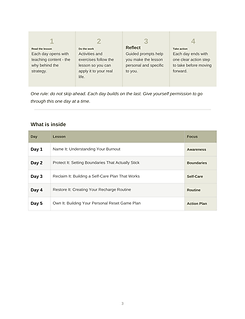

If you are exhausted, overwhelmed, and running on empty, this course was made for you. Not for the version of you that has it all together. For the real you, right now, who is tired of just getting through the day.
In just 5 days, you will:
✔ Identify what is draining your energy and why it keeps happening
✔ Learn boundary setting tools that actually stick
✔ Build a self-care routine that fits your real life, not an ideal one
✔ Create a daily structure that supports you instead of suffocating you
✔ Walk away with a personal reset plan you can return to anytime
Five focused days. Practical tools. Real results. No overwhelm.
You were not made to just survive. This course helps you start showing up for yourself again, on your own terms.


Helpful Links
The following organizations provide reliable information on health, wellness, stress, and mental well-being.
Trusted Health & Mental Health Resources
National Institute of Mental Health (NIMH)
Reliable information about mental health, stress, and emotional well-being.
National Institutes of Health (NIH)
Research-based information on health, wellness, sleep, and stress.
Centers for Disease Control and Prevention – Mental Health
https://www.cdc.gov/mentalhealth
Helpful information on stress, mental health, and emotional wellness.
American Psychological Association (APA)
Resources on managing stress, building resilience, and supporting mental health.
Substance Abuse and Mental Health Services Administration (SAMHSA)
Information and support resources for mental health and emotional well-being.
Sleep Foundation
https://www.sleepfoundation.org
Trusted guidance on improving sleep and understanding healthy sleep habits.
Wellness & Mindfulness Websites
Mind
A well-respected mental health organization offering practical advice and support on topics such as stress, anxiety, burnout, and emotional well-being.
Mental Health Foundation
https://www.mentalhealth.org.uk
A trusted source for research-based information on mental health, prevention, stress management, and building healthier communities.
Mindful
A respected mindfulness publication featuring expert articles, guided practices, and practical tools to help reduce stress and support mindful living.
Mental Health & Emotional Support
Mental Health America
Offers mental health screening tools, education, and resources for managing stress, anxiety, and emotional well being.
Anxiety Canada
Provides practical tools and evidence-based information for understanding and managing anxiety and stress.
Mindfulness & Stress Reduction
Center for Mindfulness in Medicine Health Care and Society
Educational resources on mindfulness and Mindfulness-Based Stress Reduction (MBSR).
Stress Management & Well-Being
Greater Good Science Center
https://greatergood.berkeley.edu
Research-based resources focused on happiness, emotional well-being, resilience, and healthy relationships.
HelpGuide
A trusted nonprofit resource offering practical advice on mental health, stress management, relationships, and personal growth.
Sleep & Recovery
American Academy of Sleep Medicine
Evidence-based sleep health guidance and tips for improving sleep quality and overall well-being.
Wellness Glossary
Common wellness terms explained in plain language, no fluff, no jargon.
A
Affirmations: Positive, intentional statements you repeat to yourself to shift your mindset and reinforce healthier thought patterns.
Autonomy: Your right to make decisions about your own life, body, and wellbeing without needing permission or approval from others.
B
Boundaries: Limits you set to protect your time, energy, and emotional wellbeing in relationships and situations. Boundaries are not walls. They are guidelines for how you expect to be treated.
Body Awareness: The ability to tune into physical sensations in your body, including tension, fatigue, hunger, and stress signals.
Burnout: A state of chronic stress that leads to physical and emotional exhaustion, detachment, and a feeling of ineffectiveness. Burnout does not happen overnight. It builds over time.
C
Compassion Fatigue: Emotional and physical exhaustion that comes from consistently caring for others, often at the expense of yourself. Common in caregivers, mothers, and helping professionals.
Cortisol: A stress hormone released by your body during high pressure situations. Chronically elevated cortisol can affect sleep, energy, weight, and mood.
Chronic Stress: Ongoing, long term stress that does not go away. Unlike short term stress, chronic stress wears down your body and mind over time.
E
Emotional Boundaries: Limits that protect your emotional energy and prevent you from taking on other people's feelings, problems, or moods as your own.
Emotional Exhaustion: A deep sense of being drained emotionally, often caused by prolonged stress, overgiving, or lack of adequate rest and support.
Energy Management: The practice of intentionally protecting and restoring your physical, mental, and emotional energy throughout the day.
G
Grounding: Techniques that help bring your attention back to the present moment when you feel overwhelmed, anxious, or disconnected. Examples include deep breathing, walking barefoot, or focusing on your senses.
Growth Mindset: The belief that your abilities, habits, and character can be developed over time through effort and self-awareness.
H
Holistic Wellness: An approach to health that considers the whole person, including physical, mental, emotional, social, and spiritual wellbeing, not just the absence of illness.
Habit Stacking: A strategy for building new habits by attaching them to existing ones. For example, doing a two minute breathing exercise right after your morning coffee.
M
Mental Load: The invisible cognitive work of planning, organizing, and managing responsibilities, often carried disproportionately by women.
Mindfulness: The practice of being fully present and aware in the current moment without judgment or distraction.
Mind-Body Connection: The relationship between your thoughts, emotions, and physical health. Stress and emotions can directly affect how your body feels and functions.
N
Nervous System Regulation: The process of helping your body shift from a stress or survival response back to a calm, balanced state. Practices like deep breathing, movement, and rest support this process.
Negative Self-Talk: The inner critical voice that undermines your confidence, self-worth, and ability to make progress. Recognizing it is the first step to changing it.
P
People Pleasing: The habit of prioritizing other people's needs, opinions, and comfort over your own, often at the cost of your wellbeing and boundaries.
Personal Boundaries: Limits you establish around your time, energy, relationships, and values to protect your overall wellbeing.
Present Moment Awareness: The practice of focusing your attention on what is happening right now rather than worrying about the past or future.
R
Recovery: The intentional process of resting, restoring, and rebuilding after periods of high stress, burnout, or overextension.
Resilience: The ability to adapt, recover, and keep moving forward in the face of stress, adversity, or change. Resilience is a skill, not a personality trait.
Rest: More than just sleep. Rest includes mental, emotional, social, sensory, and creative rest. Your body and mind need all of them to function well.
S
Self-Advocacy: Speaking up for your own needs, limits, and wellbeing in relationships, workplaces, and healthcare settings.
Self-Awareness: The ability to recognize your thoughts, emotions, patterns, and behaviors and understand how they affect you and those around you.
Self-Care: Intentional actions you take to support your mental, physical, and emotional health on a consistent basis. Self-care is not selfish. It is necessary.
Self-Compassion: Treating yourself with the same kindness, patience, and understanding you would offer a close friend when you are struggling or making mistakes.
Stress Response: Your body's automatic reaction to perceived threats or pressure. Also known as fight, flight, or freeze. Chronic activation of this response takes a toll on your health.
Sustainable Wellness: A realistic, flexible approach to health and self-care that fits into your actual life without requiring perfection or an all or nothing mindset.
T
Triggers: People, situations, or experiences that activate a strong emotional or stress response. Identifying your triggers helps you respond more intentionally instead of reacting automatically.
Time Boundaries: Limits you set around how you spend your time, including protecting personal time, rest time, and saying no to commitments that do not align with your priorities.
V
Values: The core beliefs and principles that guide your decisions, behavior, and sense of purpose. Living in alignment with your values reduces stress and increases overall wellbeing.
Vulnerability: The willingness to be open and honest about your experiences, feelings, and needs. Vulnerability is a sign of strength, not weakness.
W
Wellness Coaching: A collaborative, client centered process that supports you in making sustainable changes to your health, habits, boundaries, and overall wellbeing.
Worthiness: The deep belief that you deserve rest, care, support, and good things simply because you exist, not because of what you produce or accomplish.